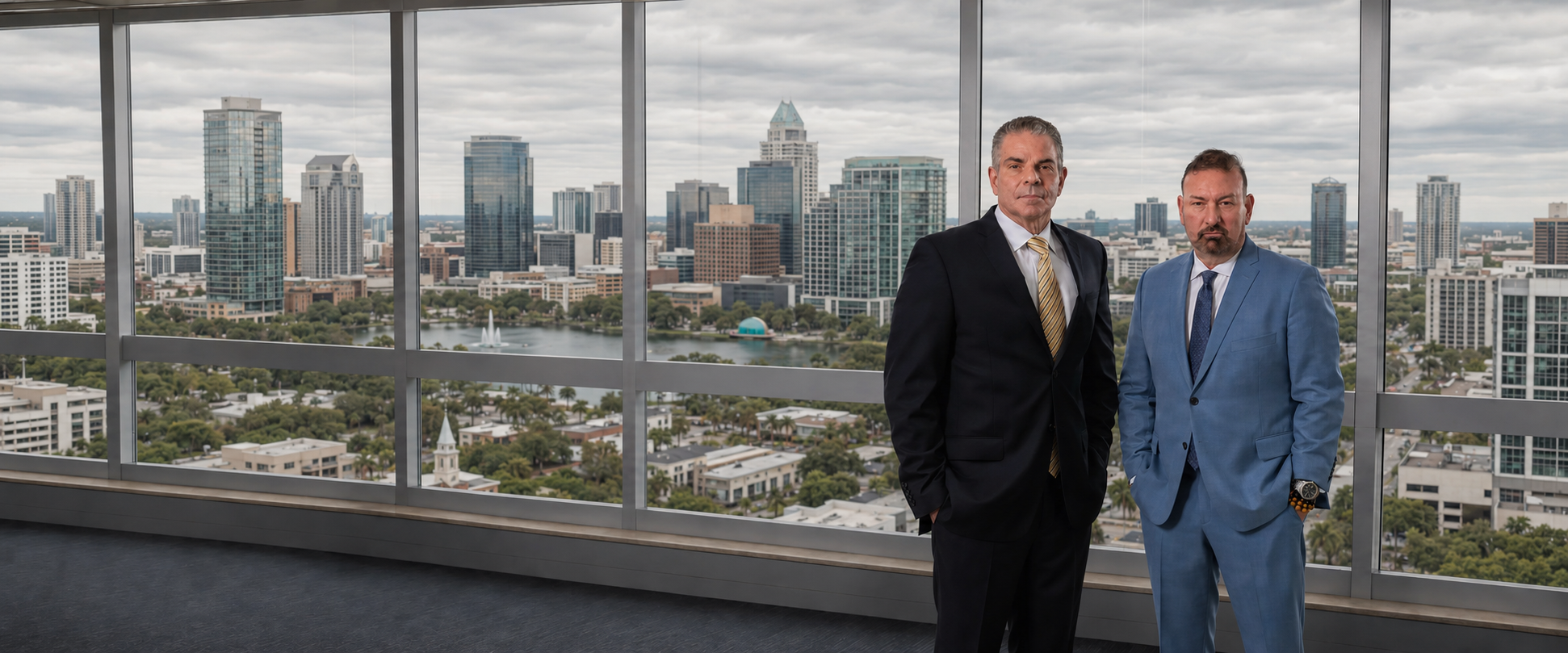
Mark J. Miller and Rick S. Jacobs with the Orlando skyline
Help after an Orlando truck crash

Orlando Truck Accident Lawyer

You have enough to manage without taking on the trucking company alone.

A truck crash can leave you hurt, missing work, and unsure who is supposed to help. Miller & Jacobs helps people injured by semis, box trucks, and delivery vehicles in Orlando. We can handle the insurance claim, find the companies involved, and explain your options while you focus on getting through the day.

Free consultation. No attorney fee unless we recover compensation for you.

Free consultation

Start with the questions you have.

No recovery, no attorney fee

Ask us how the fee agreement works.

Florida Bar since 1995

Both Mark J. Miller and Rick S. Jacobs.

Orlando office

5401 S. Kirkman Road, Suite 660.

Some of this can come off your shoulders

What can a lawyer take over while I recover?

We can deal with the claim, review the paperwork, and explain what needs your attention. You can start with the problem that is pressing hardest today.

The calls keep coming

Once we represent you, we can handle the trucking insurer’s requests and explain what you need to answer. Send us any deadline, release, or request for a recorded statement. Your own insurer may have separate notice and cooperation requirements.

The bills cannot wait

We can check available insurance, review payment notices, and ask providers about an arrangement while the claim is open. Any delay needs their agreement. A claim does not automatically stop bills or collection efforts. See our explanation of  medical bills before a settlement .

You are being asked to decide

We can review what an offer would settle and what care or income losses remain uncertain. You do not have to agree simply because an adjuster wants an answer. Tell us about any document you have already signed.

If you are calling for someone who is too hurt to speak: you can explain the situation and ask what is needed. We confirm who can authorize representation and make decisions for the injured person. You do not need a complete file for that first call.

If you are home but still hurting: you can ask for help too. Treatment visits, pain, and a few weeks of reduced work can create real problems even without a hospital stay.

Look at everyone who played a part

Can I hold the trucking company responsible?

Depending on the facts, yes. A claim may involve the driver, the trucking company, or another business whose actions helped cause the crash. We look at who did what and which insurance may apply.

If the company or its insurer denies responsibility, that is something for us to investigate. You do not have to argue with each business or work out the legal relationships on your own.

Looking beyond the driver

What the driver did

Speed, a lane change, distraction, or fatigue may be part of the picture. We compare the driver’s account with the crash evidence instead of relying only on what an insurer tells you.

What the company controlled

The work arrangement, safety decisions, and condition of the truck can matter. We look at whether the company may be responsible for the driver’s conduct, its own decisions, or both.

Who handled the load or repairs

If a shifting load or a mechanical problem contributed, we look at who loaded, inspected, or repaired the truck. Another business may be involved, but it takes evidence to connect its work to the crash.

What if the insurers keep blaming each other?

You should not have to spend your recovery being passed from one adjuster to another. We can direct each claim to the appropriate insurer, challenge an unsupported denial, and explain whether a lawsuit is an option.

Before the truck returns to service

What should be kept before the truck is repaired?

The truck and its records may be outside your control. We can ask the businesses involved to preserve what matters and decide whether an inspection is needed. That work can begin while you receive care.

01

Preserve the records

Driving logs, dispatch messages, camera video, and vehicle data may help explain the trip. We find out which systems were in use and who holds the records.

02

Check the vehicles

We assess whether an expert needs to inspect the truck, your vehicle, or particular parts before repairs or disposal. Photographs may not show every problem.

03

Trace the trip

We look for witnesses, nearby cameras, delivery records, and other sources. If a preservation request is not enough, further legal steps may be needed to obtain records.

What can the truck’s data actually show?

An electronic logging device, or ELD, records duty time. It is not required to record speed or braking. Cameras and other vehicle systems may hold different information, so we do not assume one device recorded the whole crash.

How long will the records exist?

Covered driving logs and supporting documents must be kept for six months under federal rules. Video and other records may have different retention periods. A request cannot bring back material that is already gone.

Illustration of a tractor-trailer traveling on a multilane road

Illustrative image

A question you may be asking

“I can’t get through a full shift yet. How do I keep everything going?”

Rent still comes due. The job still needs doing. And someone may be counting on you at home. Those pressures belong in the conversation, along with the medical records.

Tell us what has become harder since the crash. We can help work out which losses the claim may cover and what needs a separate plan now.

The work you cannot do

What if I’m missing shifts or cannot return to the same work?

We can document lost pay and assess whether your injury limits the work you can do in the future. How we show that depends on how you earn a living and the limits your doctor describes.

A future settlement is not a paycheck for this week. Tell us if money is running short so we can discuss available benefits and payment arrangements, as well as the injury claim.

Hourly or shift work

Keep the schedule as well as the pay stub

Save your schedules, pay stubs, and work restrictions. Note missed shifts and the dates you used paid leave. If you returned on shorter hours or lighter duties, record that change. We can explain what confirmation to request from your employer.

Self-employed or contract work

Canceled work needs a paper trail

Keep canceled bookings, invoices, tax records, and what you paid for help. A job worth $2,000 in sales may have left you much less after costs. We work through that difference so the claim reflects lost income.

A lasting limit on work

Look beyond the next paycheck

If an injury changes the work you can safely do, we look beyond the next few shifts. Medical records and, when needed, job or income experts can help show the effect on your ability to earn.

If a  spinal cord injury  creates long-term care or access needs, those costs need their own careful assessment too.

A place to begin

Let’s start with what is hardest right now.

The bills, the calls, the missing work, or the part you do not understand. Tell us what happened and what you need help sorting out.

Put the Orlando trip in context

For an Orlando crash, the exact place matters.

A ramp, loading entrance, or delivery stop can point us toward different records. Start with the route and time you remember. We can look for the details you could not collect at the scene.

Details to keep together Residents · workers · visitors
Highway trip

I-4, the Beachline, or SR 417

Save the direction of travel, nearest exit, ramp, and approximate time. Keep your own toll activity or rental-car toll statement if the trip involved toll roads. These records may help establish timing; they do not show who caused the collision.

CFX’s  E-PASS account guide  explains how to view toll transactions and run statements for a date range.
Delivery or service stop

The entrance matters too

For a collision near a hotel, shop, or loading area around International Drive or Kirkman Road, note the business address and the entrance used. Save any delivery receipt, appointment message, or witness contact you already have. A street address and the actual loading entrance may point to different views of what happened. If a truck struck you while you were walking, our pedestrian injury team can review the driver’s actions and the crossing conditions.

Speak with our Orlando office

Our office is at  5401 S. Kirkman Road, Suite 660, Orlando, FL 32819 . Call  407-465-8733  before visiting. If you have returned home, we can start by phone and discuss how to share your documents.
Truck crashes are part of our  Orlando personal injury practice . We can help you understand which claims may fit when a crash involves more than one vehicle or business.
Directions to the Orlando office →
Meet the partners

Know who you are speaking with.

Mark J. Miller and Rick S. Jacobs are both former prosecutors and have been admitted to The Florida Bar since 1995. Their biographies explain their backgrounds and courtroom experience.

During a consultation, ask who would handle your matter, how updates would work, and what information is needed to evaluate the claim. Ask how case costs are handled too; those are separate from attorney fees.

Mark J. Miller, Partner at Miller and Jacobs

Partner

Mark J. Miller

Mark’s background includes prosecution and insurance defense. He brings that experience to reviewing the evidence and the positions insurers take in injury cases.

Read Mark’s biography →
Rick S. Jacobs, Partner at Miller and Jacobs

Partner

Rick S. Jacobs

Rick previously served as an Assistant State Attorney in Miami-Dade County. His biography details his trial background and his work representing injured people.

Read Rick’s biography →
Questions that change the next step

The questions that are harder to ask.

You may already have spoken to an adjuster, had your car towed, or tried to go back to work. Tell us what has happened so far. It helps us explain the next step.

Check the filing date early. Florida generally allows two years for a lawsuit based on negligence. Exceptions and different claims can change the deadline. An open insurance claim does not, by itself, stop that clock.

Yes. A claim does not depend on the vehicle being an 18-wheeler. We examine who was driving, why the vehicle was being used, what caused the crash, and which insurance may apply. Federal trucking rules do not apply to every delivery vehicle in the same way.

A collision between the vehicles is not always necessary to have a claim. The challenge may be proving what the truck did and connecting it to your injuries. Save witness contacts and original video if you have them. If the truck left or cannot be identified, policy terms and notice requirements need prompt review.

Not necessarily. Tell us where it is, the daily charge, and whether repairs or disposal are planned. We can assess what needs documenting or inspecting and discuss how to limit further storage costs. Keep the towing notice, photos, estimate, and receipts. Avoid assuming the other insurer will pay every charge.

Workers’ compensation and a claim against a responsible third party may both be relevant. Your employment status and who caused the crash matter. The claims can affect each other, including repayment from a settlement. Tell us about benefits, employer notices, and any other lawyer already involved.

No. A policy limit is not a promise to pay that amount. Responsibility, covered losses, exclusions, and other people’s claims can affect what is available. We review the actual coverage and evidence rather than valuing your case from the size or logo of the truck.

Tell us what you believe is wrong and what could support a different account. A report is one source of information; we also examine witnesses, photos, and other records. In a covered Florida negligence claim, being more than 50% at fault bars recovery. If your share is 50% or less, the money you can recover is reduced by that share.

Tell us who took it, when, and what you were asked. If you have a copy, bring it. We can review it alongside the other evidence and discuss how to address an error or missing detail. Giving a statement does not by itself tell us whether you have a claim.